Friday, December 12, 2014

The Online Sensation: Music Auteurs Created because of Internet Possibilities

In every industry, the essential purpose is to increase capital. While sometimes not inherently highly profitable, the business side of the arts is constantly looking for ways to gain enough money to stay afloat and thrive. In the twentieth century, the music industry had developed a lucrative system where big record companies with developed distribution centers, highlighting artists through radio and TV promotions, worldwide tours, and control over record content. Many people have long been frustrated, however, with the amount of money the record companies gain at the expense of the individual artist. For example, recording costs are generally born by the artist (many times with a loan from the record company) and for every $16 CD sold, the record companies take $10 (Rapaport). Not only do they take from the artists monetarily, but the record labels are notorious for completely controlling the artist’s image and persona.
However with the invention of the Internet, there came a shattering disruption of the industry. New, unconventional distribution methods have emerged, changing all of the rules. The music industry now faces a new age of music production. Huge names are bursting on the scene from self-produced YouTube videos, and online streaming is making it possible for people to produce and sell their own albums without the costs of creating physical records or having to pay back the record labels. In the midst of these and other changes, the rise of piracy, has created a prevalent fear among the music industry giants that illegal downloading will be the death of the music industry all together. But because of shifts in the way people consume music, and by embracing the new methods, the society is actually empowering artists and driving the music world into new, potentially dynamic economic areas.
            Walter Benjamin, a German philosopher associated in the 1930’s with the Marxist Frankfort School for social and aesthetic theory, hypothesized that by making art mass produceable, one can democratize it. In Benjamin’s day, the conversation was about the new, widely accessible technology of the camera, wherein anyone could frame or create a picture, as opposed to the traditional painting method that took unusual amounts of training and time. He said in an essay, “For the first time in world history, mechanical reproduction emancipates the work of art from its parasitical dependence on ritual. To an ever greater degree the work of reproduced becomes the work of art designed for reproducibility” (Benjamin). He firmly believed that this new technology produced and distributed cultural creations and therefore had emancipatory potential (Benjamin). By “mechanical reproduction”, the camera unmasked the mystery of art production, and made art much more accessible to many more members of society; democratizing both production and consumption. Much to the chagrin of today’s big record labels, Benjamin might be happy with our new technology that allows musicians from basically anywhere to produce and distribute their own music to the masses. With the Internet, new artists have control over their own material, and are not (directly) limited by commercial pressures to mold their identity or product. And the chance to become a big star, in theory, is available to anyone.
Figure # 1 :  the youtube world fell in love with him like this, and made him a superstar
            Many artists have launched prominent and sustained careers by putting homemade videos on YouTube. Justin Bieber, for example, started out as a kid playing acoustic guitar online. His now manager discovered his videos and signed him at 13-years-old. Justin Beiber has since created a #1 album and three top 10 singles, been nominated for three Grammys, and grossed $44 million on his concert tour, “My World Tour” (Ford). Another example is the hip hop duo Karmin, who started by filming covers in a basement, and have now scored a double-platinum hit, appeared on Saturday Night Live, and the cover of Rolling Stone Magazine. Rapper Solja Boy initially self-published his single “Crank That (Soulja Boy)” which in September of 2007 hit #1 on the Billboard charts for seven weeks (Staff). 
Figure # 2:Pentatonix in their own house, singing for their youtube channel
 Or Pentatonix, who initially started/was discovered by a reality television show, “The Sing Off,” which won them a record deal. About a year later were dropped by that label (read the interview here) and started a YoubTube video to promote themselves. So even though they may not have started organically, they saved their careers by doing so. They have since toured around the world and are currently nominated for a Grammy Award for their mash up of daft punk songs. All of these artists were able to carve clout and autonomy for themselves in the world of music because of the twenty-first century egalitarian access via YouTube.
Along with YouTube, websites like “Band Camp” and “Reverbnation” allow artists to self-publish, self-promote, and ultimately sell without the commercial restraints and economic hand-cuffs of a record label, thus giving them more control over their own music/image etc.. For example Lana Del Rey signed with a record company in 2007, but after she released her 1st album digitally, she bought herself out of that contract. When her 2014 album was released, it became the #1 on the Billboard Top 200 list (click here for more info).  Now able to completely control her own artistry, Lana has become an auteur in her own right. Thanks to the easy access of the Internet around the globe, her artistry and her economics are her own.
From such easy Internet access, the online phenomenon of “pirating” has come about. Pirating is a phrase that references the downloading or accessing of something online without purchasing it.  While it is illegal, it is nearly impossible to enforce regulations against piracy, at least completely, and so it is becoming more and more common. There is a deep concern among the music industry that pirating will kill the business completely. The New York Times discussed the dangers of piracy to the industry. In it, the music federation blamed the 30% decline in global music sales from 2004-2009 on the culture of “tolerated apathy toward illegal file-sharing” (Pfanner). CDs fell by about 16 percent worldwide, causing overall industry revenue to decline to about $15.8 billion in 2009 from about $17.5 billion a year earlier (Pfanner). Album sales have decreased; the top 25% of artists sell less records. 
Figure # : really music sales haven't decreased, just record sales 
But the interesting development is that the other 75% of artists are actually benefiting from filesharing and profiting (Ernesto). People have more opportunity to discover new artists if they can browse for free. More often than industry managers might expect, people actually buy the music after they have pirated it for free (Ernesto). “Ironically, so-called piracy is thus promoting exactly what copyright is meant to protect: the creation and dissemination of new artistic works” (Neal). It is the albums and artists that are over-promoted that are suffering; the ones that make the record labels most of their income, it is becoming harder for artists to be marketed to the top of the charts. From Benjamin’s perspective, because of the freedoms of the Internet, it is becoming harder for the record companies to control their customers because of how many people are pirating music that they simply like to listen to as opposed to those that are pushed forward by the record labels.
Some artists have used this increasing awareness of people using bittorrents and piracy to their advantage. Iron Maiden, for example, used analysis drawn from music consulting firm, Musicmetric to find out where their music was being downloaded the most. They discovered they had a huge amount of illegal downloaders—and therefore assumed a large fan base—and tailored their next tour around the fan demographic found via bittorrent analysis. Gregory Mead, CEO and co-founder of Musicmetric said, "With their constant touring, [the] report suggests Maiden have been rather successful in turning free file-sharing into fee-paying fans” (Rutherford) utilizing the way of the current system to their advantage.
Figure # :Radiohead pay-what-you-want album
Anther band that turned this current world of pirating into a beneficial situation was Radiohead. They kept hearing about so many people stealing their music—downloading it illegally—and so they decided to just give it out. They launched their next album, In Rainbows, in a digital, download, pay-what-you-want model. Most people paid nothing for the download, and even still, pre-release sales for the album grossed more profit than the total sales from the album Hail to the Thief, which had sold 100,000 copies (Nme news). Thom Yorke stated that Radiohead had made more money from digital sales of In Rainbows than the digital sales of all previous Radiohead albums combined.
Few people expected the band to have the capacity or ambition to put an album out completely on their own. Thom Yorke told TIME magazine, "I like the people at our record company, but the time is at hand when you have to ask why anyone needs one. And, yes, it probably would give us some perverse pleasure to say 'F___ you' to this decaying business model” (Tyrangiel).
The music industry is changing. Companies and artists are adjusting to this world of Internet reality. While the big players in the industry might be frustrated and upset about this change, it is inevitably going to continue to democratize and explode in different directions. Benjamin would be proud and excited for our country; everyone who knows how to press record on his or her computer can be an artist, and can get their art to the world without the commercial pressure of the bourgeois culture machine pushing down on the man. How progressive.


Benjamin, Walter, “THE WORK OF ART IN THE AGE OF MECHANICAL
REPRODUCTION”
http://www.wbenjamin.org/walterbenjamin.html

Ford, Rebecca; Schillaci, Sohpie; Carlson, Erin, Justin Bieber By the Numbers: 18 Key
Stats From His Music Empire and Beyond. Hollywood Reporter. March 1, 2012

Neal, Meghan, Sweet Irony: How Piracy Leads to More Hit Music. January 2, 2014


NME News, Radiohead reveal how successful 'In Rainbows' download really was
Facts for pay-what-you-want release finally made public. October 15, 2008

Patrizio, Andy, Smart Data. Citeworld.

Pfanner, Eric. New York Times—global business: Music Industry Counts the Cost of
Piracy. New York Times online. January 21, 2010

Rapaport, Diane, How Record Companies Make Money. Taxi.

Rutherford, Kevin, Iron Maiden Using Music Piracy to Drive Concert Ticket Sales.
Billboard.com. December 26, 2013

Staff, DX, Soulja Boy, Will.i.am, Akon Take YouTube Live. Hiphoppdx News
November 12, 2008

Tyrangiel, Josh, Radiohead Says: Pay What You Want.  TIME magazine online. Oct. 01,
2007


Tuesday, November 18, 2014

Constructed, Imposed, Neurosis in "The Bachelor"

The Bachelor. One of reality TV's most successful ventures.
Debuting in 2002, it is the longest running reality romance show (Reisner). 18 seasons if you count its spin-off The Bachelorette, and still today enjoying incredibly impressive viewership ratings. Even in it's lowest-rated season (the 8th), there were 9 million viewers (Goldstein).

Figure #1: Jimmy Kimmel meme pointing out the show is not actually about "finding true love"
I have to admit that I was an avid fan of the show. I religiously tuned in every monday night, and gossiped about the contestants with my girlfriends, and predicted who would be the chosen fiance every week. I was completely caught up and thoroughly embarrassed that I loved it so much.

Then one episode (I think my fourth season in) I had a strange epiphany: I'd seen this before. These phrases, these conversations, these 'emotions,' were all something I could, at this point, have written myself, because, I realized,...every season is the same.

If you have ever watched the show (any season, really any episode) you'll have heard some or all of the following: (some of these come from Lisa Newlin's Blog

“I’m really starting to feel something for him”
"I think I'm falling..."

"I'm not here to make friends"

“We have a real connection”

"...here for the right reasons"

“I didn’t expect to fall in love” (this one's my favorite. you didn't? you're on a TV show for the express purpose of falling in love)

"...On this Journey..."  

“I didn’t think it would be this hard”

"This is the most difficult decision yet" 

“My walls are really starting to come down”

“I didn’t know I could feel this way”(Newlin)

"In the most Dramatic Event in Bachelor/Bachelorette History..."

How can each season have such repeated moments with entirely different casts of people, entirely different past experiences and backgrounds; ending up with the exact same dialogue, without a script?

The first reason for such repetitiveness is: familiarity.
The producers design for repetitiveness because viewers appreciate reliability/familiarity/routine. The show has come up with a formula that they know works. So the producers edit and cut the footage, and in some cases direct the contestants so that they fit into the mold that will produce similar results and the producers have proven is successful.

Robert Thompson, founding director of the Bleier Center for Television & Popular Culture at Syracuse University said, "Counterintuitively, imposing a structure is the smartest way to keep viewers engaged. Producers need to force each season to essentially replicate the season before it" (Goldstein). Bottom line - Because people like the familiarity. Our (real) lives are chaotic and messy, especially in the realm of romance. Thompson continues, "What The Bachelor does is take present-day romance—a liberating, confusing, overwhelming, free-for-all—and lace it back up into a corset."Caitlin Duffy, a Ph.D. candidate in psychology at Northwestern University said that humans seek out ritual because, “From a social psychology standpoint, [the ritual] presents a stable, predictable world. We like to have rules and script to follow... Especially when it’s something like romantic relationships that are so important to our lives and happiness and well-being" over which we have so little control (Goldstein).


The formula of the show is in its structure, it's predictability; there's safety and satisfaction in the ritual of it all. We don't actually care about the individuals, we care about the process. Through editing (after the first night of introductions) the producers cut out nearly every element of unique identifiable traits/characteristics/conversations of the contestants, especially if those unique characters break their mainstream attractiveness. Many times, at the end of the season, people will remark something to the effect of, "I didn't know she was funny!" Or in the case of season eight Bachelorette, Emily Maynard, a close friend of hers relayed that "More than anything, she's passionate about her faith" (Carbone), but we never saw that passion of hers on television because it was potentially controversial. A large part of her personality was completely hidden/cut from the aired material. 

They have to flatten the "characters" to make them universal; the less distinct the contestants the more viewers can live vicariously through them, the more viewers can impose themselves into the adventures/romance in the show. 

We like the rules, we appreciate the strict structure, ceremony, and ritual. In an almost carnivalesque way, when those rules are slightly bent, we love it even more; plus it gives the advertisers an excuse to claim, "the most dramatic episode yet."

So the producers know how much we love familiarity and they edit/tailor the footage to fit the same formula every season. But I am going to venture that they can actually predict the contestants' behavior to be similar in every season.

Which leads us to the 2nd reason for repetitiveness: the psychological set-up.
This show can be replicated season by season because its specific rules set up a particular psychological environment.  My theory here is that even if they didn't edit the shoots, the producers could basically predict the behavior of the contestants because of the psychological maze they are stuck running through. They are in a controlled environment, doing essentially a pointed study on John Bowlby's "Attachment Theory". I believe "Attachment Theory" can explain much of the predictable, patterned behavior exhibited on the show.

John Bowlby's Attachment Theory:
Traditionally studied in children, the basic concept of "Attachment Theory" is this: if an infant has a caregiver who fulfills his/her physical and emotional needs, then that caregiver becomes a secure attachment figure in an infant's life. A child will not feel secure enough to be independent or explorative unless he or she has a secure attachment to their caregiver. The caregiver acts like a basic rod of security, helping the child face surprises, opportunities, and challenges life presents simply by being a secure base. Without a secure attachment figure in a child's life, neurosis and even psychosis may occur.

In the 1980s, Cindy Hazan and Phillip Shaver applied the idea to adult--specifically romantic--relationships. This is why we all "act like children" in trying to form romantic relationships. Adults are seeking the same type of security in a romantic relationship that a caregiver provides to an infant. 

Below, on the right, is a diagram of an "attachment seeking cycle" or a security-based strategy that shows how people attempt to reduce their anxiety about attachment. The diagram outlines a normal human reaction sequence. 

In reviewing this cycle, it becomes obvious why there are fundamental problems in the Bachelor contestants attempting to fulfill this cycle on the show, The Bachelor:

Figure #2 : attachment-seeking cycle
1) "Everyday Activities"
Contestants on the Bachelor have everyday activities that are not "everyday activities."  All of the contestants live together in one big house. They are not allowed to text, email, facebook, or be in any contact with friends outside of the house, etc. Their "everyday activities" are wholly centered around one man (or woman) even when he (or she) is not there. The contestants are contractually obligated to operate with the sole purpose of romantically pursuing the star of the show.

2) Perceive Triggering Conditions
Contestants are only allowed a small allotted time with the star, on restricted and planned out dates. Then they have to watch and listen as other contestants return to the home and converse about their dates and their developing romantic relationship (their growing attachments) with the star. These conversations inevitably ...

3) Provokes Anxiety
Without emotional security, anxiety follows. This is the trigger and basis for many of the conversations about other contestants (comparing each other, being jealous of others, etc.) which are repeated throughout the show and season to season. These, of course, are natural responses to the situation which breeds more lack of attachment. 

4) Seeks closeness to Partner 
Bowlby describes a scene with children: "In most young children the mere sight of mother holding another baby in her arms is enough to elicit strong attachment behaviour. The older child insists on remaining close to his mother, or on climbing on to her lap. Often he behaves as though he were a baby" (Bowlby, 260). The anxiety/jealously of having an attachment figure give attention to a "rival" transfers to adults.

The contestant, who had one perception of his/her attachment to the bachelor/ette now questions where they stand and engages in attachment-seeking behavior. He or she seeks to be physically and psychologically closer to the person to whom they want to be attached. At the next regulated ceremony, where they are allowed time with the star, the contestants ask for affirmation/security in his/her feelings about the contestant - "do you still feel the way you felt on our last date?"

5) Partner Responds Positively
In the rules of the show, it is the essential premise that continues the show: the star CANNOT affirm any individual contestant until the season finale. It is in their contract to not say the words, "I love you" or to indicate in any way they have chosen one candidate before the final episode. The bachelor/ette cannot affirm completely and is contractually obligated NOT to show a secure attachment to anyone individual.

6) Can Reduce Anxiety, but cannot eliminate it. Here is the predictable, and unfortunately entertaining aspect of the show: watching people deal with anxiety in their insecure attachments.  

The entire premise of the show imposes a constructed neurosis on the contestants: a constant struggle with secure attachment which will lead them to predictable (film-able) attachment-seeking, often wild or desperate behaviors and conversations that make for good TV.

So, why do we continually watch this repeating soap opera?  In our own chaotic and unstructured lives (especially love lives) we want something stable. We love the familiarity, the formula, the repetition, the ritual, the structure. We enjoy watching others squirm under the pain and anxiety of an insecure attachment because we ourselves experience so much of it. Especially in romance. We watch them struggle as a catharsis and validation that our own feelings are so painful and complicated. We watch others make the same, repeating mistakes in the love arena, maybe so we don't have to make them. And we keep watching through the end of the season for the pay off: at the end someone ends up with a secure attachment that we are all ultimately searching for.

Figure #3: 1 man secure attachment to 24 women; 24 women insecure attachment with 1 man

Sunday, October 26, 2014

Musicals--Movies--Masterpieces? Mistake.

Many filmmakers have attempted to transform musical theater masterpieces into an acclaimed movie.   Though the two might carry the same name or title, they invariably differ as these genres are deeply varying artistic and entertainment experiences for the audience and they demand new, sometimes conflicting, elements for success in their medium. Transforming a musical theater piece into a cinematic experience is difficult at best, and seldom successful to the level of the original theatrical experience. Tony-winning winning musicals that have been made into movies have historically not been greeted with the same encouraging response from critics as their story’s debut. For three examples, the Tony-award-winning musicals “West Side Story,” “Hairspray,” and “Les Miserables” had much less of a positive response on screen than they did on Broadway. Among the many dynamics at work in the transformation from musical theater to film, three factors centrally affect this process: the economics of production, audience expectations, and the demand on imagination or suspension of disbelief. The differences of these three elements between the two media are in a large part of what makes this transition so difficult. 
Producing a Broadway musical costs a substantial amount of money, but making a movie, on average, costs more than four times as much. According to an article in the New York Times, the cost to produce a Broadway musical ranges anywhere between $25,000- $25 million[1] (Healy).  Producer Kevin Davenport writes in his blog, "In the 2010-11 season, there were 43 shows produced for a total of $209.7 million, or an average of $4,876,744" (Davenport) [2] The most expensive show to date is “Spiderman: Turn Off the Dark”, which cost $75 million to produce—and that was considered a wild outlier in the Broadway community. By comparison, Hollywood films cost are multiple times higher. In 2007, the average cost to produce a major motion picture was $100 million (Healy).[3] In transitioning from musical to movie, a Herculean effort must be made to recoup the cost of production and provide investors with an acceptable rate of return. For example, the New York theatrical production of the 1987 Les Miserables cost $4.5 million to mount, and gained $11 million in opening sales (Jones).[4] On the other hand, the recent movie version of Les Miserables is said to have cost approximately $61 million to produce and then generated over $100 million in revenue (Gilbert).[5] The film studios must generate several times their cost in revenues to net a good economic number. Hence, they need to attract a wide, substantial general audience, with exciting ads and trailers that translate into box office successes.
One of the main ways that a film gets marketed is with the help of “big-name” actors being associated with the film, who can attract their established fan base. So, for example, all three musicals mentioned above cast well-known actors in an effort to sell out the box office. In West Side Story, the main actress, Natalie Wood, was cast as “Maria”, the Spanish lead character, because she was a major draw at the time. But the choice of Natalie actually defeated a major element of the story line, which is a modern-day Romeo and Juliet story, complete with racial bigotry, and their love overlooking racial differences and backgrounds, as two gangs (New York and Puerto Rican) carry on an ethnic rivalry. Natalie Wood was neither Puerto Rican nor a singer.
Figure #1: Russian Natalie Wood's portrayal of a Puerto Rican discounts one of the messages from the show completely
In fact, the producers’ first choice for the leading actress was the even more famous and even “whiter” European, Audrey Hepburn, who dropped out when she became pregnant (Susman).[6] Hence, any sort of authenticity in this rough-and-tumble story was made debatable because of Natalie’s own lack of true ethnicity or musical talent. But because of the high costs, the producers understandably changed some of the essence of the story by casting a big name to ensure viewership.
The same economically-driven casting choices occurred in “Hairspray.” Actors like Michelle Pfeiffer, Christopher Walken, and Amanda Bynes were not cast because of their contributions to the musical world, but because of their familiar names and loyal fans. People want to come see actors try and sing. Even casting those actors with musical experience, like John Travolta and Zac Efron, was first and foremost an attempt to get a famous name, not just necessarily the best person for the musical job. The producers of Les Miserables, as well, made similar decisions and cast A-list actors that were not necessarily the best fit for the role. Many critics agreed that Russell Crowe was not cast for his singing ability, but for his name’s potential revenue pull. His voice was rough and flat and strained in many spots and audiences had mixed reviews. Christopher Orr of the Atlantic said it graciously: “There is an odd, unexpected dignity to the sight of a man so obviously out of place and yet trying so hard to make the best of it” (Orr).[7] Popular singer, Adam Lambert, voiced the concern of many with his twitter post: “the (Les Miserables) score suffered massively with great actors PRETENDING to be singers” (Gonzales)[8]

Figure #2: Russell Crowe cast for his big name, not his big vocals. (Russell Crowe Singing "Stars"... VS. Tony-award winner, Philip Quast in the 10th anniversary singing the same song) 
Christopher Orr additionally commented, “Committed fans of the musical are likely to have their affections reaffirmed. The less devout, however, may conclude that in this case more is less, and fidelity is not always a virtue” (Orr). The economics of film drive decisions to a large extent, and so the final product has natural and often irritating limitations. In the end, the audience does generally want to hear great voices if it’s a musical and does want to believe that the characters fit the storyline.
            Other limitations, besides economics, come with the different mediums and require more of audience’s willing suspension of disbelief.  A phrase coined by the philosopher Samuel Taylor Coleridge, suspension of disbelief or “poetic faith,”[9] meaning that people suspend their judgment with regard to the improbability of any given narrative if there is something of human interest or a semblance of truth (Warren). People voluntarily disregard the implausibility or lack-of-reality in order to be entertained. As British Aesthetics specialist Eva Sharper says, “Unless disbelief were suspended, we could not avoid the puzzle resulting from being moved by what we do not believe ever really happened or ever existed” (Schaper)[10]. In the early days of film there was more assumed suspension of disbelief than we have today—the audience didn’t really believe the world was black and white. But as film technology becomes more and more sophisticated, audiences expect their viewing experience to be more and more realistic. From the book, “The Art of Watching” about cinematic literacy, the author says, “Through film, fantasy assumes the shape and emotional impact of reality. The technological history of film can in fact be viewed as a continual evolution toward greater realism…in fact, by creating images that are larger than life, films have sometimes been made to seem more real than reality”[11] This move to make film more and more realistic makes the requirement for the audience to have a suspension of disbelief less and less.
 In a film, there are infinite possibilities of visuals; in a live theatrical setting there are naturally some restrictions. Live theater does not have the option for post-production effects, for example, and so the audience has to fill in the blanks with their own imagination. Shakespeare himself said to his audience, “'tis your thoughts that now must deck our kings…turning accomplishment of many years into an hourglass" (Shakespeare).[12] It is the audience’s imagination that must dress the “kings” in royal settings, because of the nature of a play has to be more minimal than a movie.
A musical theater production requires an additional layer of suspended disbelief because of the music. The entire medium is based in a world wherein people frequently burst into song or dancing, with perfect rhyme and orchestration, where everyone knows the same choreography instantly. This type of behavior is not generally found in real life; a highly unrealistic set of events, but because of the audience’s suspension of disbelief, they are able to connect to the story. Watching a movie, the audience finds it a little harder to believe that everyone just happens to know the songs.
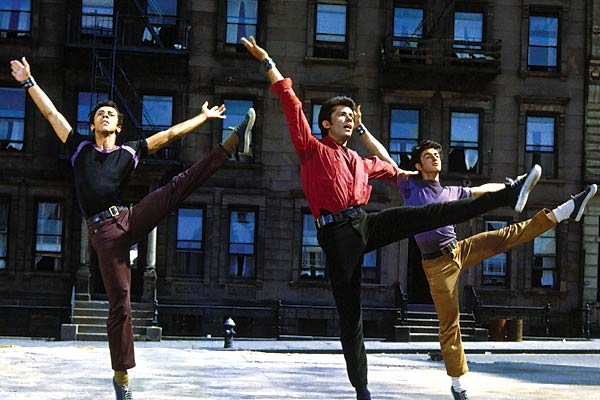
Figure #3: "Gang Fights" with snapping are not as intimidating in real life
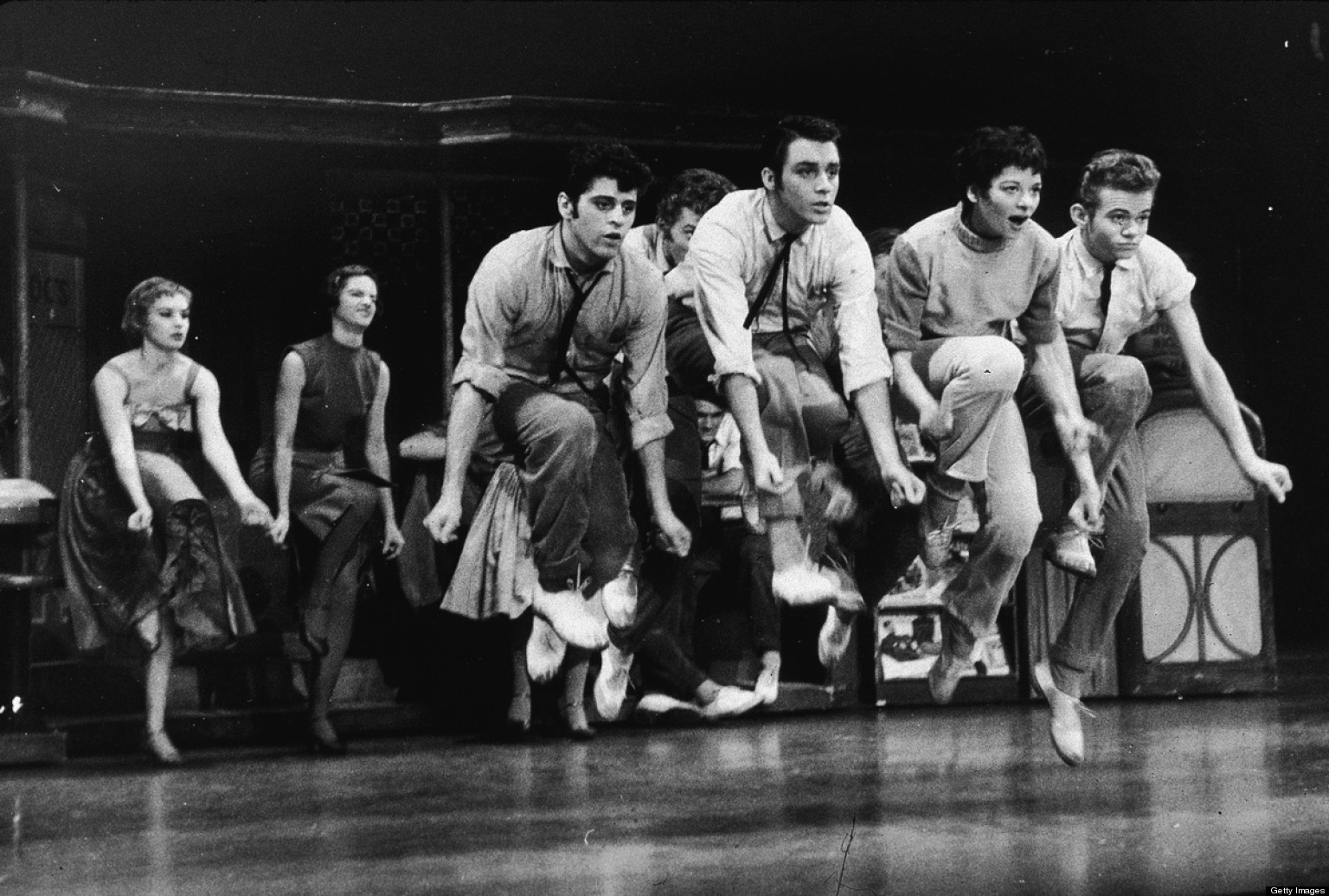
            In West Side Story, the iconic Jerome Robbins choreography did not translate to the silver screen as successfully as it romped across the stage. On stage, the gang fight portrayed through dancing was the perfect amount of exaggerated, emotional movement to reach the back of the theater. On the screen it came across as slightly ridiculous or out of place. Well-known reviewer, Pauline Kale, called it a “simpering, sickly romantic ballet” (Ebert)[13]. The intensity of a gang fight is hard to convey with pirouettes.
s.
Figure #4: Pointed toes and leaps don't strike fear into the heart of the other New York Gang.


  In Hairspray, as a different kind of suspension of disbelief, the main character’s mother on stage is always played by a very large, gruff man. The gag is obvious to the audience; so much so, in some productions the mother wears a full beard in costume. When “she” sings, it’s clearly a man’s 
Figure #5 :John Travolta's sincerity doesn't let the joke play
voice. In the movie they kept with the tradition and cast John Travolta as the mother, but they dressed him so convincingly in drag that he was supposed to pass as a woman realistically. In his sincerity, in the attempt to play the cross-dressing as reality, the joke was lost to the movie audience.
In general, expectations from a film-going audience are different from a musical. The latter relies heavily on vocals to portray emotion because the audience is so far removed from the facial expressions. Movies however have consistent close-up shots of subtle emotions. In Les Miserables, the attempt was to have the singing, but make is as “real and raw”[14] as possible, according to director Tom Hooper, so that the viewing film audience would believe (Edelman). Some people raved that his methods were successful, turning a musical into close-up emotion. However, many were frustrated, or nearly exhausted with the exaggeration of emotion. Christopher Orr said, “The second or third time we watch a face fill the screen with notes tender or tragic, the effect is genuinely arresting. (But) the 22nd or 23rd time…!” It is difficult to maintain that level of intensity and emotion to any audience, especially a movie one.
            The basic structure of these genres are so different, they reach different audiences with different expectations. For economics’ sake, they cast big, A-list actors as main roles, because they already have a fan base. However, when audiences see a big star, like Natalie Wood, Russell Crowe, or Amanda Bynes, advertised in the film, they have expectations for the kind of genre it will be. Almost always, the musical role is completely unlike the kind of roles that made them famous.  They undoubtedly could be a disappointment to their most devoted fans that expect something else. Another audience expectation is the length of a production. The average length of a movie is shorter than a musical. A movie-going audience has the expectation and attention span going into a film, and a potential frustration is the sheer additional length a musical brings; without an intermission, a 157-minute long movie (Les Miserables) is long.  And of course the expectation of people that know the musical as a live theater piece are almost always disappointed simply because it’s a different medium.
            This artistic venture of adapting one genre into a completely new medium is a risky one. In the case of transferring a musical theater piece into a movie, because of the differences in the cost of production, suspension of disbelief and audiences’ expectations, the filmic version has an incredibly difficult job of keeping the original integrity of the message and the art. I would like to mention that the three films discussed in this paper were actually monetarily successful; audiences enjoyed and acclaimed all three. However, in comparison to the original medium, because of the difficult artistic choices needed to succeed in a movie, some of the art of the initial piece was lost in translation. This is the risk and challenge when adapting anything, how to keep the integrity of artistry from the first medium into the next. While I think it is a noble pursuit, I think with musical theater to film, because of the reasons explored in my paper, it has yet to be completely successful in that transfer. 


[1]Healy, Patrick, “The Staggering Cost of Broadway” New York Times Online. Published July 21, 2011. http://artsbeat.blogs.nytimes.com/2011/07/21/the-staggering-cost-of-broadway/?_php=true&_type=blogs&_r=0
[2] Davenport, Kevin. "What's the Average Cost of Putting on a Broadway Show?" The Producer's Perspective. Blog posted June 7, 2012  https://www.theproducersperspective.com/my_weblog/2012/06/whats-the-average-cost-of-putting-on-a-broadway-show.html
[4] Jones, Kenneth, “The Country House review,” 18 May 2003, as quoted in playbill, October 26, 2014
[5] Gilbert, Ryan. “Les Miserable Movie Passes the $100 Million Mark at the Box Office” Broadway.com “Buzz” Published Jan 7, 2013. http://www.broadway.com/buzz/166454/les-miserables-movie-passes-the-100-million-mark-at-the-box-office/
[6] Susman, Gary. “25 Things You Might Not know About West Side Story” Posted Oct. 18 2011. http://news.moviefone.com/2011/10/18/25-things-you-may-not-know-about-west-side-story/
[7] Orr, Christopher. “The Extravagent Melodrama of “Les Miserables”; The Altlantic Online Entertainment Archives. Posted December 25, 2011.  http://www.theatlantic.com/entertainment/archive/2012/12/the-extravagant-melodrama-of-les-miserables/266549/
[8] Gonzalez, Sandra. “Russell Crowe Responds to Adam Lamburt’s Criticism” Entertainment Weekly. Published Jan 2, 2013. http://popwatch.ew.com/2013/01/02/russell-crowe-adam-lamberts-les-mis-criticism/
[9]Warren, Matt “Suspension of Disbelief: The representation of poetic faith through time-based media” http://mattwarren.com.au/resources/SuspensionofDisbelief.pdf
[10] Schaper, Eva, “Fiction and the Suspension of Disbelief”, The British Journal of Aesthetics 1978 18(1):31-44
[11] The Art of Watching (p. 2) Accessed via Learning Suite.
[12] Shakespeare, William, Henry V, Prologue. http://shakespeare.mit.edu/henryv/henryv.1.0.html
[13] Ebert, Roger, “Great Movie: West Side Story” Publised February 15, 2004. http://www.rogerebert.com/reviews/great-movie-west-side-story-1961
[14] Edelman, Adam, “Russell Crowe Crows about ‘Raw and Real’ Singing in ‘Les Miserables’” New York Daily News Online. Posted January 2, 2013 http://www.nydailynews.com/entertainment/tv-movies/russell-crowe-hits-back-adam-lambert-les-mis-slam-article-1.1231595