Many filmmakers have attempted to
transform musical theater masterpieces into an acclaimed movie. Though the two might carry the
same name or title, they invariably differ as these genres are deeply varying
artistic and entertainment experiences for the audience and they demand new,
sometimes conflicting, elements for success in their medium. Transforming a
musical theater piece into a cinematic experience is difficult at best, and seldom
successful to the level of the original theatrical experience. Tony-winning
winning musicals that have been made into movies have historically not been
greeted with the same encouraging response from critics as their story’s debut.
For three examples, the Tony-award-winning musicals “West Side Story,”
“Hairspray,” and “Les Miserables” had much less of a positive response on screen
than they did on Broadway. Among the many dynamics at work in the
transformation from musical theater to film, three factors centrally affect
this process: the economics of production, audience expectations, and the
demand on imagination or suspension of disbelief. The differences of these
three elements between the two media are in a large part of what makes this
transition so difficult.
Producing a
Broadway musical costs a substantial amount of money, but making a movie, on
average, costs more than four times as much. According to an article in the New
York Times, the cost to produce a Broadway musical ranges anywhere between $25,000-
$25 million[1]
(Healy). Producer Kevin Davenport
writes in his blog, "In the 2010-11 season, there were 43 shows produced
for a total of $209.7 million, or an average of $4,876,744" (Davenport) [2]
The most expensive show to date is “Spiderman: Turn Off the Dark”, which cost
$75 million to produce—and that was considered a wild outlier in the Broadway
community. By comparison, Hollywood films cost are multiple times higher. In
2007, the average cost to produce a major motion picture was $100 million (Healy).[3]
In transitioning from musical to movie, a Herculean effort must be made to
recoup the cost of production and provide investors with an acceptable rate of
return. For example, the New York theatrical production of the 1987 Les
Miserables cost $4.5 million to mount, and gained $11 million in opening sales
(Jones).[4]
On the other hand, the recent movie version of Les Miserables is said to have
cost approximately $61 million to produce and then generated over $100 million
in revenue (Gilbert).[5]
The film studios must generate several times their cost in revenues to net a
good economic number. Hence, they need to attract a wide, substantial general
audience, with exciting ads and trailers that translate into box office
successes.
One of the main
ways that a film gets marketed is with the help of “big-name” actors being
associated with the film, who can attract their established fan base. So, for
example, all three musicals mentioned above cast well-known actors in an effort
to sell out the box office. In West Side Story, the main actress, Natalie Wood,
was cast as “Maria”, the Spanish lead character, because she was a major draw
at the time. But the choice of Natalie actually defeated a major element of the
story line, which is a modern-day Romeo and Juliet story, complete with racial
bigotry, and their love overlooking racial differences and backgrounds, as two
gangs (New York and Puerto Rican) carry on an ethnic rivalry. Natalie Wood was
neither Puerto Rican nor a singer.
 |
| Figure #1: Russian Natalie Wood's portrayal of a Puerto Rican discounts one of the messages from the show completely |
In fact, the producers’ first choice for the
leading actress was the even more famous and even “whiter” European, Audrey
Hepburn, who dropped out when she became pregnant (Susman).[6]
Hence, any sort of authenticity in this rough-and-tumble story was made
debatable because of Natalie’s own lack of true ethnicity or musical talent.
But because of the high costs, the producers understandably changed some of the
essence of the story by casting a big name to ensure viewership.
The same
economically-driven casting choices occurred in “Hairspray.” Actors like
Michelle Pfeiffer, Christopher Walken, and Amanda Bynes were not cast because
of their contributions to the musical world, but because of their familiar
names and loyal fans. People want to come see actors try and sing. Even casting
those actors with musical experience, like John Travolta and Zac Efron, was
first and foremost an attempt to get a famous name, not just necessarily the
best person for the musical job. The producers of Les Miserables, as well, made
similar decisions and cast A-list actors that were not necessarily the best fit
for the role. Many critics agreed that Russell Crowe was not cast for his
singing ability, but for his name’s potential revenue pull. His voice was rough
and flat and strained in many spots and audiences had mixed reviews.
Christopher Orr of the Atlantic said it graciously: “There is an odd, unexpected dignity to the sight of a man so
obviously out of place and yet trying so hard to make the best of it” (Orr).[7]
Popular singer, Adam Lambert, voiced the concern of many with his
twitter post: “the (Les Miserables) score suffered massively with great actors
PRETENDING to be singers” (Gonzales)[8]
 |
| Figure #2: Russell Crowe cast for his big name, not his big vocals. (Russell Crowe Singing "Stars"... VS. Tony-award winner, Philip Quast in the 10th anniversary singing the same song) |
Christopher Orr additionally commented, “Committed fans of the musical are likely to have their affections
reaffirmed. The less devout, however, may conclude that in this case more is
less, and fidelity is not always a virtue” (Orr). The economics of film
drive decisions to a large extent, and so the final product has natural and
often irritating limitations. In the end, the audience does generally want to
hear great voices if it’s a musical and does want to believe that the
characters fit the storyline.
Other
limitations, besides economics, come with the different mediums and require
more of audience’s willing suspension of disbelief. A phrase coined by the philosopher Samuel Taylor Coleridge,
suspension of disbelief or “poetic faith,”[9]
meaning that people suspend their judgment with regard to the improbability of
any given narrative if there is something of human interest or a semblance of
truth (Warren). People voluntarily disregard the implausibility or
lack-of-reality in order to be entertained. As British Aesthetics specialist
Eva Sharper says, “Unless disbelief were suspended, we could not avoid the
puzzle resulting from being moved by what we do not believe ever really
happened or ever existed” (Schaper)[10].
In the early days of film there was more assumed suspension of disbelief than
we have today—the audience didn’t really believe the world was black and white.
But as film technology becomes more and more sophisticated, audiences expect
their viewing experience to be more and more realistic. From the book, “The Art
of Watching” about cinematic literacy, the author says, “Through film, fantasy
assumes the shape and emotional impact of reality. The technological history of
film can in fact be viewed as a continual evolution toward greater realism…in
fact, by creating images that are larger than life, films have sometimes been
made to seem more real than reality”[11]
This move to make film more and more realistic makes the requirement for the
audience to have a suspension of disbelief less and less.
In a film, there are infinite
possibilities of visuals; in a live theatrical setting there are naturally some
restrictions. Live theater does not have the option for post-production
effects, for example, and so the audience has to fill in the blanks with their
own imagination. Shakespeare himself said to his audience, “'tis your thoughts
that now must deck our kings…turning accomplishment of many years into an
hourglass" (Shakespeare).[12]
It is the audience’s imagination that must dress the “kings” in royal settings,
because of the nature of a play has to be more minimal than a movie.
A musical theater
production requires an additional layer of suspended disbelief because of the
music. The entire medium is based in a world wherein people frequently burst
into song or dancing, with perfect rhyme and orchestration, where everyone
knows the same choreography instantly. This type of behavior is not generally
found in real life; a highly unrealistic set of events, but because of the
audience’s suspension of disbelief, they are able to connect to the story.
Watching a movie, the audience finds it a little harder to believe that
everyone just happens to know the songs.
 |
| Figure #3: "Gang Fights" with snapping are not as intimidating in real life |
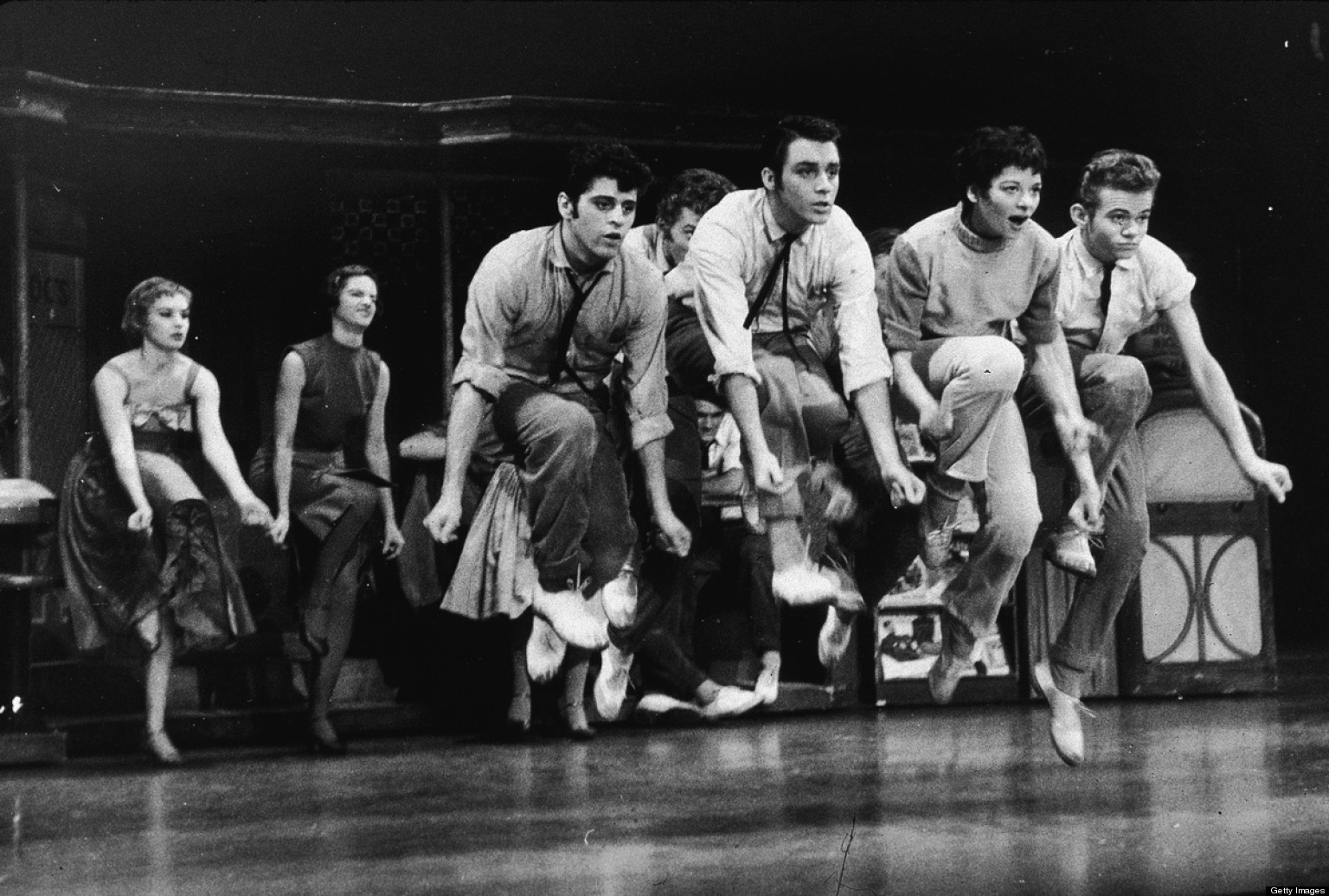
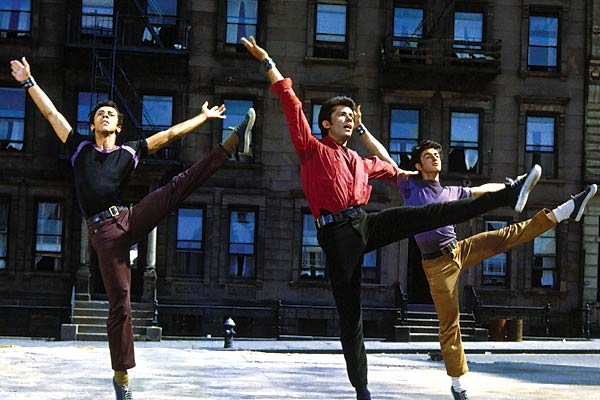
In
West Side Story, the iconic Jerome
Robbins choreography did not translate to the silver screen as successfully as
it romped across the stage. On stage, the gang fight portrayed through dancing was the perfect amount of exaggerated, emotional movement to reach the back of
the theater. On the screen it came across as slightly ridiculous or out of
place. Well-known reviewer, Pauline Kale, called it a “simpering, sickly
romantic ballet” (Ebert)[13].
The intensity of a gang fight is hard to convey with pirouettes.
s. |
| Figure #4: Pointed toes and leaps don't strike fear into the heart of the other New York Gang. |
In Hairspray, as a different kind of suspension of disbelief, the
main character’s mother on stage is always played by a very large, gruff man.
The gag is obvious to the audience; so much so, in some productions the mother
wears a full beard in costume. When “she” sings, it’s clearly a man’s
 |
| Figure #5 :John Travolta's sincerity doesn't let the joke play |
voice. In
the movie they kept with the tradition and cast John Travolta as the mother,
but they dressed him so convincingly in drag that he was supposed to pass as a
woman realistically. In his sincerity, in the attempt to play the
cross-dressing as reality, the joke was lost to the movie audience.
In general,
expectations from a film-going audience are different from a musical. The
latter relies heavily on vocals to portray emotion because the audience is so
far removed from the facial expressions. Movies however have consistent
close-up shots of subtle emotions. In Les Miserables, the attempt was to have
the singing, but make is as “real and raw”[14]
as possible, according to director Tom Hooper, so that the viewing film
audience would believe (Edelman). Some people raved that his methods were
successful, turning a musical into close-up emotion. However, many were
frustrated, or nearly exhausted with the exaggeration of emotion. Christopher
Orr said, “The second or third time we watch a face fill the screen with notes
tender or tragic, the effect is genuinely arresting. (But) the 22nd
or 23rd time…!” It is difficult to maintain that level of intensity
and emotion to any audience, especially a movie one.
The
basic structure of these genres are so different, they reach different
audiences with different expectations. For economics’ sake, they cast big,
A-list actors as main roles, because they already have a fan base. However,
when audiences see a big star, like Natalie Wood, Russell Crowe, or Amanda
Bynes, advertised in the film, they have expectations for the kind of genre it
will be. Almost always, the musical role is completely unlike the kind of roles
that made them famous. They
undoubtedly could be a disappointment to their most devoted fans that expect
something else. Another audience expectation is the length of a production. The
average length of a movie is shorter than a musical. A movie-going audience has
the expectation and attention span going into a film, and a potential
frustration is the sheer additional length a musical brings; without an
intermission, a 157-minute long movie (Les Miserables) is long. And of
course the expectation of people that know the musical as a live theater piece
are almost always disappointed simply because it’s a different medium.
This
artistic venture of adapting one genre into a completely new medium is a risky one.
In the case of transferring a musical theater piece into a movie, because of
the differences in the cost of production, suspension of disbelief and
audiences’ expectations, the filmic version has an incredibly difficult job of
keeping the original integrity of the message and the art. I would like to
mention that the three films discussed in this paper were actually monetarily
successful; audiences enjoyed and acclaimed all three. However, in comparison
to the original medium, because of the difficult artistic choices needed to
succeed in a movie, some of the art of the initial piece was lost in translation.
This is the risk and challenge when adapting anything, how to keep the
integrity of artistry from the first medium into the next. While I think it is
a noble pursuit, I think with musical theater to film, because of the reasons
explored in my paper, it has yet to be completely successful in that transfer.
[1]Healy,
Patrick, “The Staggering Cost of Broadway” New York Times Online. Published
July 21, 2011. http://artsbeat.blogs.nytimes.com/2011/07/21/the-staggering-cost-of-broadway/?_php=true&_type=blogs&_r=0
[2] Davenport,
Kevin. "What's the Average Cost of Putting on a Broadway Show?" The
Producer's Perspective. Blog posted June 7, 2012 https://www.theproducersperspective.com/my_weblog/2012/06/whats-the-average-cost-of-putting-on-a-broadway-show.html
[3] Healy,
Patrick, “The Staggering Cost of Broadway” http://artsbeat.blogs.nytimes.com/2011/07/21/the-staggering-cost-of-broadway/?_php=true&_type=blogs&_r=0
[4] Jones,
Kenneth, “The Country House review,” 18 May 2003, as quoted in playbill,
October 26, 2014
[5] Gilbert, Ryan. “Les Miserable Movie Passes the $100
Million Mark at the Box Office” Broadway.com “Buzz” Published Jan 7, 2013. http://www.broadway.com/buzz/166454/les-miserables-movie-passes-the-100-million-mark-at-the-box-office/
[6] Susman,
Gary. “25 Things You Might Not know About West Side Story” Posted Oct. 18 2011.
http://news.moviefone.com/2011/10/18/25-things-you-may-not-know-about-west-side-story/
[7] Orr,
Christopher. “The Extravagent Melodrama of “Les Miserables”; The Altlantic
Online Entertainment Archives. Posted December 25, 2011. http://www.theatlantic.com/entertainment/archive/2012/12/the-extravagant-melodrama-of-les-miserables/266549/
[8] Gonzalez,
Sandra. “Russell Crowe Responds to Adam Lamburt’s Criticism” Entertainment
Weekly. Published Jan 2, 2013. http://popwatch.ew.com/2013/01/02/russell-crowe-adam-lamberts-les-mis-criticism/
[9]Warren, Matt
“Suspension of Disbelief: The representation of poetic faith through time-based
media” http://mattwarren.com.au/resources/SuspensionofDisbelief.pdf
[10] Schaper, Eva,
“Fiction and the Suspension of Disbelief”, The British Journal of Aesthetics
1978 18(1):31-44
[11] The Art of
Watching (p. 2) Accessed via Learning Suite.
[12]
Shakespeare, William, Henry V, Prologue. http://shakespeare.mit.edu/henryv/henryv.1.0.html
[13] Ebert,
Roger, “Great Movie: West Side Story” Publised February 15, 2004. http://www.rogerebert.com/reviews/great-movie-west-side-story-1961
[14] Edelman,
Adam, “Russell Crowe Crows about ‘Raw and Real’ Singing in ‘Les Miserables’”
New York Daily News Online. Posted January 2, 2013 http://www.nydailynews.com/entertainment/tv-movies/russell-crowe-hits-back-adam-lambert-les-mis-slam-article-1.1231595



No comments:
Post a Comment